" height="29.827907037894708px" id="hxyS9cMDT" width="121.00001289658667px"/></svg>)
About the Project
About the Project
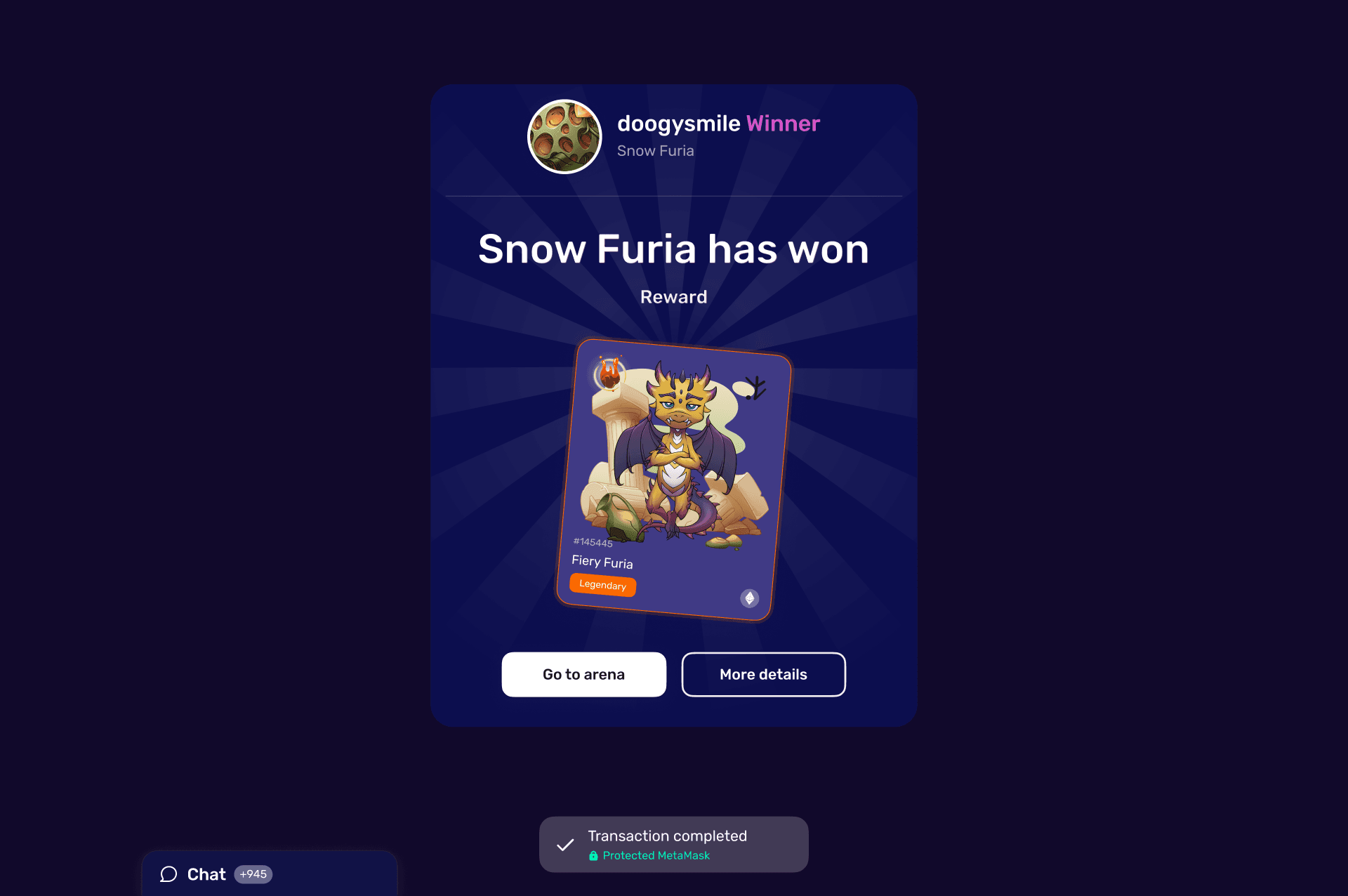
Dragon Arena is a PvP feature concept for an NFT platform designed to transform NFT dragons from static collectibles into interactive game assets. The goal was to increase user engagement by creating meaningful gameplay around NFT ownership. Players could challenge each other using their dragons and compete for NFT or cash rewards.
Dragon Arena is a PvP feature concept for an NFT platform designed to transform NFT dragons from static collectibles into interactive game assets. The goal was to increase user engagement by creating meaningful gameplay around NFT ownership. Players could challenge each other using their dragons and compete for NFT or cash rewards.

Problem
Problem
NFT dragons became passive collectibles after purchase, leaving users with little incentive to return or actively engage with the platform.
NFT dragons became passive collectibles after purchase, leaving users with little incentive to return or actively engage with the platform.
Hypotheses
Hypotheses
I believed that turning NFT dragons into active gameplay assets through PvP battles would encourage users to return more often, interact with one another, and get more value from their NFT collections.
I believed that turning NFT dragons into active gameplay assets through PvP battles would encourage users to return more often, interact with one another, and get more value from their NFT collections.
Design Approach
Design Approach
Before moving into the interface, I focused on the core product challenges. The experience needed to give NFT dragons a meaningful role beyond ownership, encourage users to return through repeatable gameplay, keep the battle flow simple, and connect all key interactions into one cohesive experience. These principles became the foundation for the Battle Hub and the overall PvP journey.
Before moving into the interface, I focused on the core product challenges. The experience needed to give NFT dragons a meaningful role beyond ownership, encourage users to return through repeatable gameplay, keep the battle flow simple, and connect all key interactions into one cohesive experience. These principles became the foundation for the Battle Hub and the overall PvP journey.



Success Metrics
Success Metrics
Battle Participation Rate — % of users who participate in at least one PvP battle.
Battle Participation Rate — % of users who participate in at least one PvP battle.
Repeat Battle Rate — % of users who return to play additional battles.
Repeat Battle Rate — % of users who return to play additional battles.
Retention Rate (D1 / D7 / D30) — % of users who return to the platform after their first battle.
Retention Rate (D1 / D7 / D30) — % of users who return to the platform after their first battle.
Time to Create a Battle — Average time required to create and send a battle challenge.
Time to Create a Battle — Average time required to create and send a battle challenge.